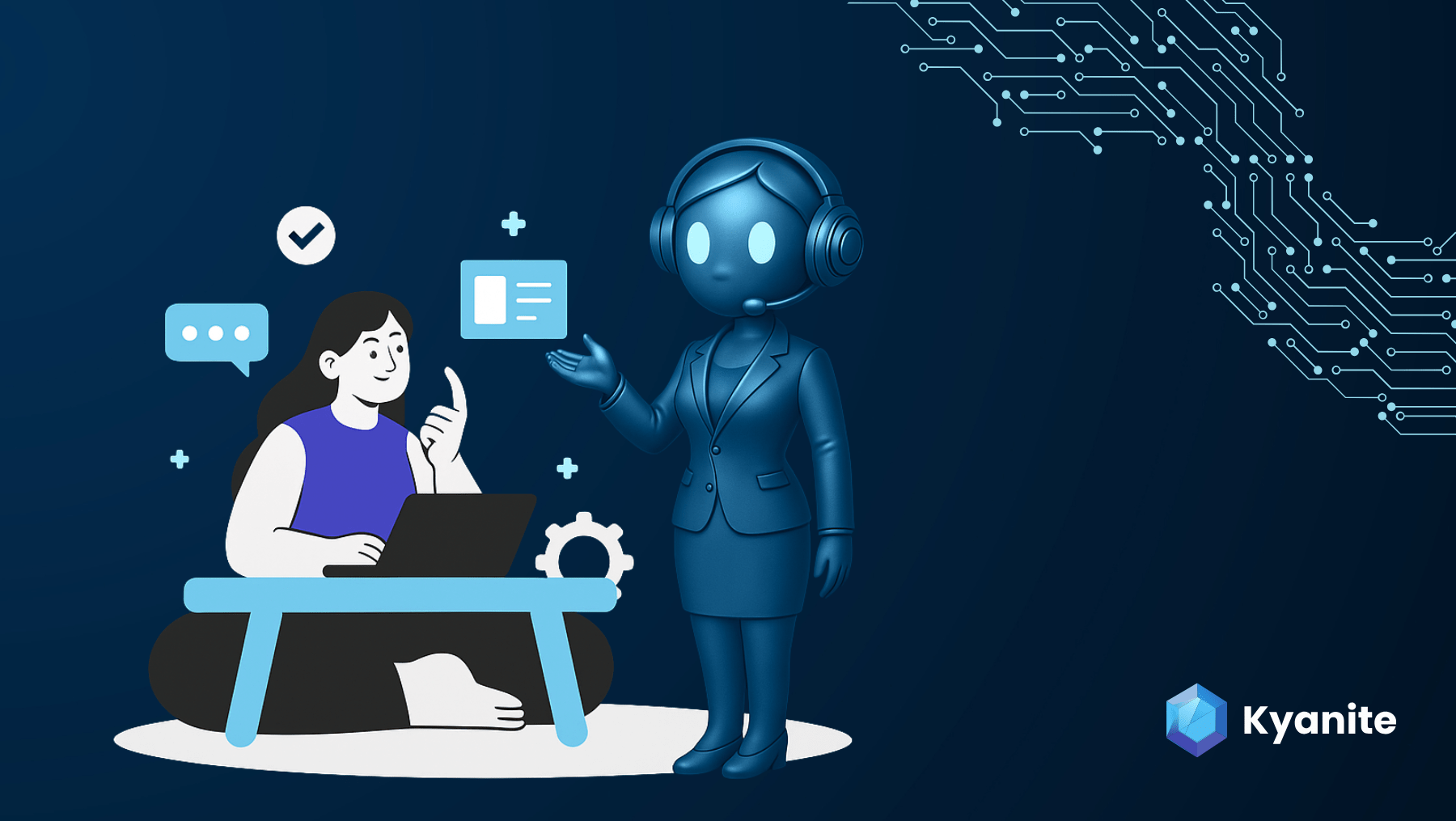
As AI continues to advance, a familiar question emerges in the legal sector: will AI replace human lawyers? At Kyanite, we believe the real future is collaboration, where AI supports people rather than replaces them.
Our platform, and Karli, our digital legal assistant, are designed to relieve legal professionals of repetitive administrative work so they can focus on complex, high-value tasks. Karli does not take jobs. It empowers people to do their best work.
From Replacement to Partnership
Early conversations about AI often focused on replacing humans. In reality, AI works best as a partner. Law depends on judgement, ethics, persuasion and client relationships, all of which require human intelligence.
- AI manages the repetitive: administrative tasks, onboarding, compliance checks and document handling.
- Humans do what machines cannot: legal reasoning, strategy, negotiation, and client care.
- Together they scale better: AI frees capacity so people can concentrate on the work that matters most.
Karli was designed with this partnership in mind. It enables lawyers, paralegals and support staff to spend less time on routine tasks and more on meaningful legal work.
Collaboration in Practice
Here is what this looks like inside a modern law firm using Karli:
- Client enquiry and triage
Karli gathers information, checks for conflicts and routes enquiries so staff can focus on meaningful follow-up. - Onboarding and risk checks
Karli performs compliance checks and flags risks. Lawyers review and decide, saving valuable time. - Document preparation
Karli drafts templates and manages versions, while lawyers refine and apply their expertise. - Workflow orchestration
Karli tracks deadlines, prompts actions and ensures nothing is missed, keeping human users firmly in control. - Continuous improvement
Karli learns firm-specific processes over time, integrating with existing systems to become more effective.
At every stage, Karli supports people. Humans remain central, with AI running in the background to keep work flowing smoothly.
Why This Model Works
- Efficiency and productivity
Karli removes repetitive tasks, giving legal teams more time for substantive work. - No job losses, better roles
Karli works alongside teams rather than replacing them, strengthening capacity without increasing headcount. - Consistency and compliance
Actions are logged and standardised, reducing errors and ensuring regulatory compliance. - Better client experience
Faster responses and smoother workflows lead to higher satisfaction. - Future-proofing the workforce
Firms that embrace AI collaboration empower their staff and stay ahead in a changing sector.
How Kyanite and Karli Enable Collaboration
Kyanite’s mission is to support legal professionals, not replace them. Karli was created by lawyers, for lawyers, to integrate seamlessly into existing workflows and enhance what teams can achieve.
- Tailored to law firms: Karli fits naturally into onboarding, compliance, document workflows and enquiry management.
- Integrates seamlessly: It works alongside case management systems and CRM tools.
- Learns and improves: Karli becomes more effective with use, adapting to firm-specific routines.
- Delivers measurable value: Time saved, errors reduced and workflows accelerated, all without job cuts.
This is why Kyanite positions AI as a partner to people, not a threat.
A Vision of the Future
Imagine a law firm where Karli manages onboarding, associates receive timely prompts, and document drafting is a shared process between human expertise and AI speed. Workloads increase without added stress, and staff feel supported rather than replaced.
This is not a distant vision. It is already happening in forward-thinking firms.
Conclusion
The future of legal work is not about AI replacing humans. It is about humans and AI working together to deliver better outcomes. At Kyanite, we are proud to build tools that aid, support and elevate people, helping legal professionals thrive in a modern, technology-enabled environment.
If your firm is ready to explore human and AI collaboration, get in touch with us today. Together, we can build a future where people and technology work side by side.