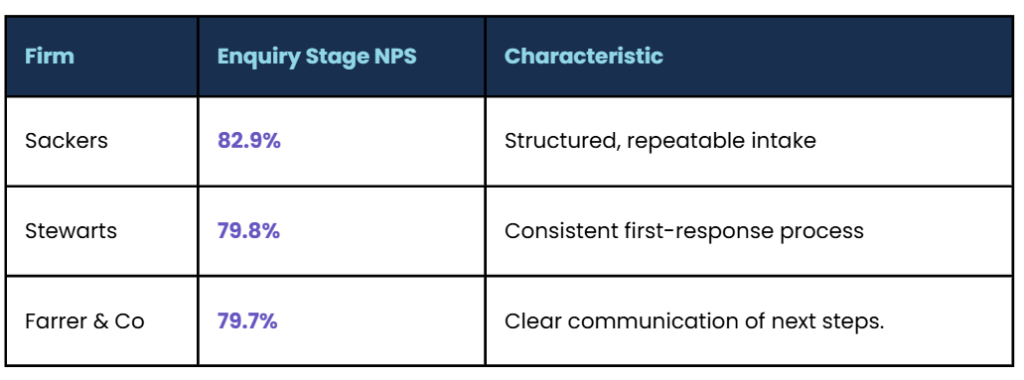
These firms are not outliers by luck. They have made deliberate investments in the process that surrounds the legal work, particularly at the point of first contact.
Why the enquiry stage is where clients form lasting opinions
The behavioural science here is well-established. First impressions are formed quickly and are disproportionately resistant to revision. A client who experiences a slow, disorganised initial contact does not typically recalibrate their view upwards when the legal work turns out to be excellent. They arrive at the relationship already cautious.
The three most common failure points at the enquiry stage, reflected consistently in client feedback data, are delayed or absent responses, repeated requests for the same information, and a lack of process transparency.
Enquiries that go unacknowledged for hours or days, or are routed through generic inboxes with no clear ownership, create immediate doubt about the firm’s reliability. Asking a prospective client to re-submit details they have already provided signals poor internal coordination and erodes trust before the relationship has properly started. And when firms fail to explain the next steps, clients experience anxiety that is entirely avoidable.
It is worth being precise about the nature of these failures. They are not attitude problems. The lawyers and staff involved are not, in the main, indifferent to the client experience. These are workflow problems. They arise from the absence of a structured, repeatable intake process, not from a lack of care.
The enquiry stage is almost entirely a process question, not a people question. When firms fix the process, the experience improves, without asking anyone to work harder or differently.
What separates high-NPS firms from the rest
Firms that consistently score well on enquiry-stage NPS share four operational disciplines. None of them require exceptional technology. All of them can be systematised.
The first is immediate, intelligent acknowledgement, not a generic auto-reply, but a response that reflects the substance of the enquiry and signals it has been received by the right people. The second is single, structured data capture, where clients are asked for everything required, once, in a format that feeds directly into the firm’s systems without manual re-entry. The third is clear communication of next steps, clients are told, promptly, what they can expect to happen and when. The fourth is consistent execution, meaning the quality of the experience does not vary based on which member of staff handles the enquiry or what time of day it arrives.
That last point matters more than it might appear. Inconsistency is itself a trust problem. When clients cannot predict the quality of their experience, they cannot rely on the firm. High-performing firms eliminate that variability not through micromanagement, but through process design.
The business case for fixing the enquiry process
The commercial consequences of a poor enquiry experience are real and measurable, even if they rarely appear in management information.
The most direct impact is lost instructions. A proportion of prospective clients who enquire with a firm and receive a poor initial experience will either not proceed or will instruct a competitor. They typically do not tell the firm why. The instruction simply does not materialise, and it is attributed to factors other than the process.
The referral economics are equally significant. Word-of-mouth is the dominant source of new instructions for most private client and commercial law firms. Referrals are generated by the whole client experience including, and often especially, the intake stage. A client who was made to feel like an inconvenience at the point of first contact is unlikely to become a source of referrals, regardless of the quality of the subsequent legal work.
The conversion data is consistent: enquiry-to-instruction conversion rates are materially higher at firms with structured, responsive intake processes. This is not a marginal effect. For firms handling significant volumes of new enquiries, the revenue impact of even a modest improvement in conversion is substantial.
How Karli addresses the enquiry experience gap
Kyanite’s product, Karli, is built specifically around the enquiry and onboarding stage of the client journey, the part of the process where, as the data makes clear, most firms are underperforming.
Karli handles enquiry capture and initial client onboarding through a structured, automated workflow. When a new enquiry arrives, Karli acknowledges it immediately, gathers the information the firm needs through a single, structured interaction, and presents the matter to the relevant lawyer for review and approval before any substantive response is sent.
This is what Kyanite calls the lawyer-in-the-loop model. The lawyer retains full oversight and control. Every step is approved by a qualified professional before it reaches the client. The automation handles the process; the lawyer handles the judgement.
The result is a consistent, professional first impression that does not depend on which member of staff is available, what time of day the enquiry arrives, or the current state of the firm’s inbox. The experience the client receives at 9am on a Tuesday is the same experience they receive at 6pm on a Friday.
For firms managing significant enquiry volumes, this consistency is the difference between a reliable client experience and an unpredictable one. And as the ClearlyRated data shows, consistency at this stage is one of the clearest differentiators between high-NPS firms and the rest.